TL;DR AEO is the practice of getting cited inside AI-generated answers, and it isn't SEO with a new label. ChatGPT, Gemini, and Claude each retrieve from a different index (Bing, Google, Brave), but they reward the same content shape: a direct answer in the first 40 to 60 words, question-shaped headings, dense facts, schema, and fresh dates. Audit once against that standard and you lift all three.
A CRM buyer used to open ten blue links and decide for themselves. Now they open one chat window and ask a question. The answer comes back already filtered, already compared, and already narrowed to a short list of names. If your brand is not one of those names, you were cut before you knew you were in the running.
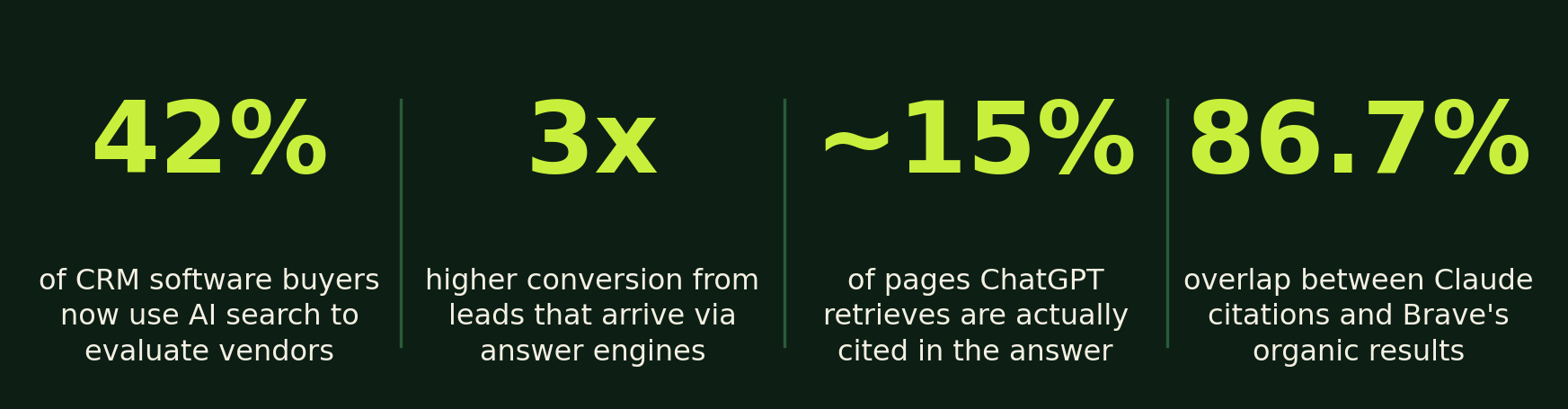
This is Answer Engine Optimization, or AEO: the practice of improving how often and how accurately your business shows up inside AI-generated answers. It is not a future trend. 42% of CRM software buyers now use AI search as part of how they evaluate vendors (HubSpot, January 2026), and the traffic that does arrive from these engines tends to convert better because the buyer already did their research before they clicked.
The infrastructure read Most teams will hear "we need to show up in AI" and treat it as a content sprint. It is not a content problem. It is the same problem we see with stalled pipeline and murky attribution: growth is limited by infrastructure, not effort. AEO rewards structure, schema, freshness, and consistency across channels. Those are operations decisions, not blog topics.
What's the difference between AEO and SEO?
SEO wins a ranked list and earns the click. AEO makes you the source an answer engine quotes, whether anyone clicks or not. They share a foundation, and the page that ranks helps, but it isn't automatically the page that gets cited. The scoreboard changes from rankings and CTR to mentions, citations, share of voice, and AI referral traffic.
SEO and AEO share a foundation, and improving one often lifts the other. But the goal is different, which means the scoreboard is different. SEO is built to win a ranked list and earn the click. AEO is built to be the source an engine quotes, whether or not anyone clicks at all.
| SEO | AEO | |
|---|---|---|
| Primary goal | Rank higher and earn the click | Get mentioned or cited inside the AI answer |
| Who you optimize for | A human scanning a results page | The answer engine first, the reader second |
| Success metrics | Rankings, impressions, clicks, CTR | Mentions, citations, share of voice, AI referral traffic |
| Content shape | Keyword-targeted pages and meta descriptions | Structured, self-contained, extractable passages |
| Main levers | Backlinks, domain authority, technical SEO | Answer clarity, structure, schema, multi-source trust |
The practical takeaway: you do not throw out your SEO work. You extend it. The page that ranks is not automatically the page that gets cited, and that gap is where this audit lives.
Which search index does each AI engine use?
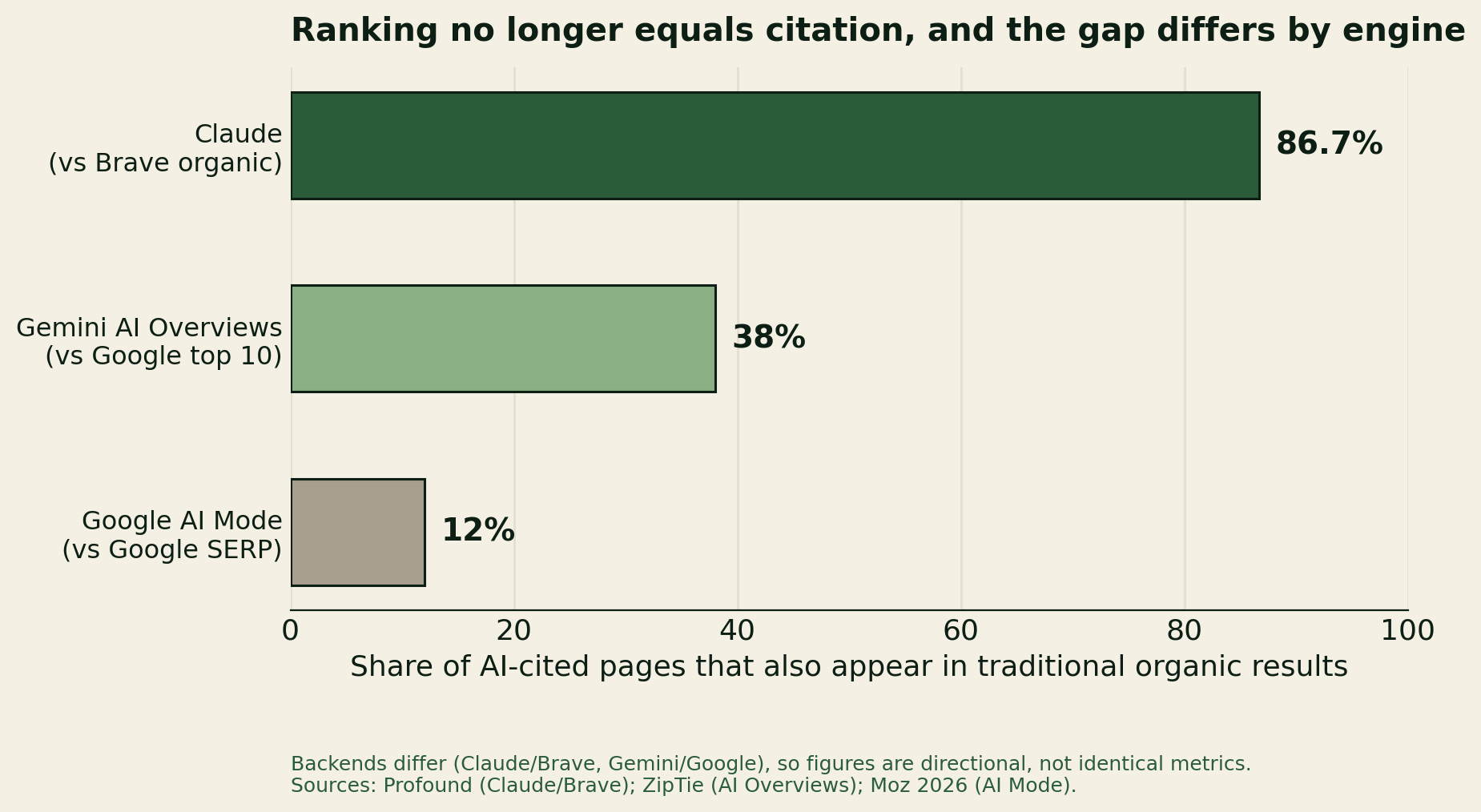
ChatGPT Search retrieves from Bing. Gemini and Google AI Overviews retrieve from Google's organic index. Claude retrieves through Brave Search, with 86.7% of its citations overlapping Brave's organic results. The same page can be the top answer in one engine and invisible in another. HubSpot AEO tracks ChatGPT, Perplexity, and Gemini, but not Claude, so that one you check by hand.
Here is the detail that gets lost in most AEO advice. "Optimize for AI" is not one job. The major answer engines do not share a retrieval system. Each one reads a different slice of the web before it writes a word.
- ChatGPT Search retrieves from the Bing index.
- Gemini and Google AI Overviews retrieve from Google's organic index, with a Gemini layer re-ranking on top.
- Claude retrieves through Brave Search. An independent analysis found 86.7% overlap between Claude's citations and Brave's organic results (Profound).
That means a page can be the top answer in one engine and invisible in another, using the exact same content. And it raises a problem most HubSpot teams will not notice on their own dashboard.
The blind spot HubSpot AEO tracks ChatGPT, Perplexity, and Gemini. It does not track Claude. Claude runs on a different index (Brave) and, per Anthropic's documentation, applies no preferred-publisher list and respects all robots.txt directives. That makes it the most level playing field of the three, the one place a focused, well-structured niche brand can outrank a household name on content quality alone. If you optimize only to what the HubSpot dashboard shows you, Claude is a measurement gap you have to close by hand.
How the three compare:
| Engine | Retrieval index | What it rewards | In HubSpot AEO? |
|---|---|---|---|
| ChatGPT Search | Bing | Structured, extractable passages; strong domain authority; freshness. Shows a bias toward earned media in trusted publications over brand-owned pages. | Yes |
| Gemini / AI Overviews | Google organic | Passage-level extractability, entity density, and E-E-A-T as a pass/fail gate. Increasingly cites pages that do not rank in the classic top 10. | Yes |
| Perplexity | Own index + web | Always shows sources. Rewards clear, citable claims and broad multi-source presence. | Yes |
| Claude | Brave Search | Concise, current, intent-matched answers. Constitutional-AI training favors expert, trustworthy sources. No preferred-publisher list: a level field. | No. Audit by hand |
Table data synthesized from Profound, AirOps, ZipTie, Moz (2026), and Anthropic and HubSpot product documentation.
How does each AI engine choose what to cite?
All three work on a version of retrieval-augmented generation: pull candidate pages, evaluate them, then synthesize an answer that cites a handful. The differences are in what survives the filter.
ChatGPT (runs on Bing)
ChatGPT Search does not return a ranked list. It retrieves a wide candidate set and then cites only the pages it can confidently attribute a specific claim to. The filter is brutal: one large analysis of 548,534 pages across 15,000 prompts found ChatGPT cites only about 15% of the pages it retrieves (AirOps). The rest are pulled in, evaluated, and discarded.
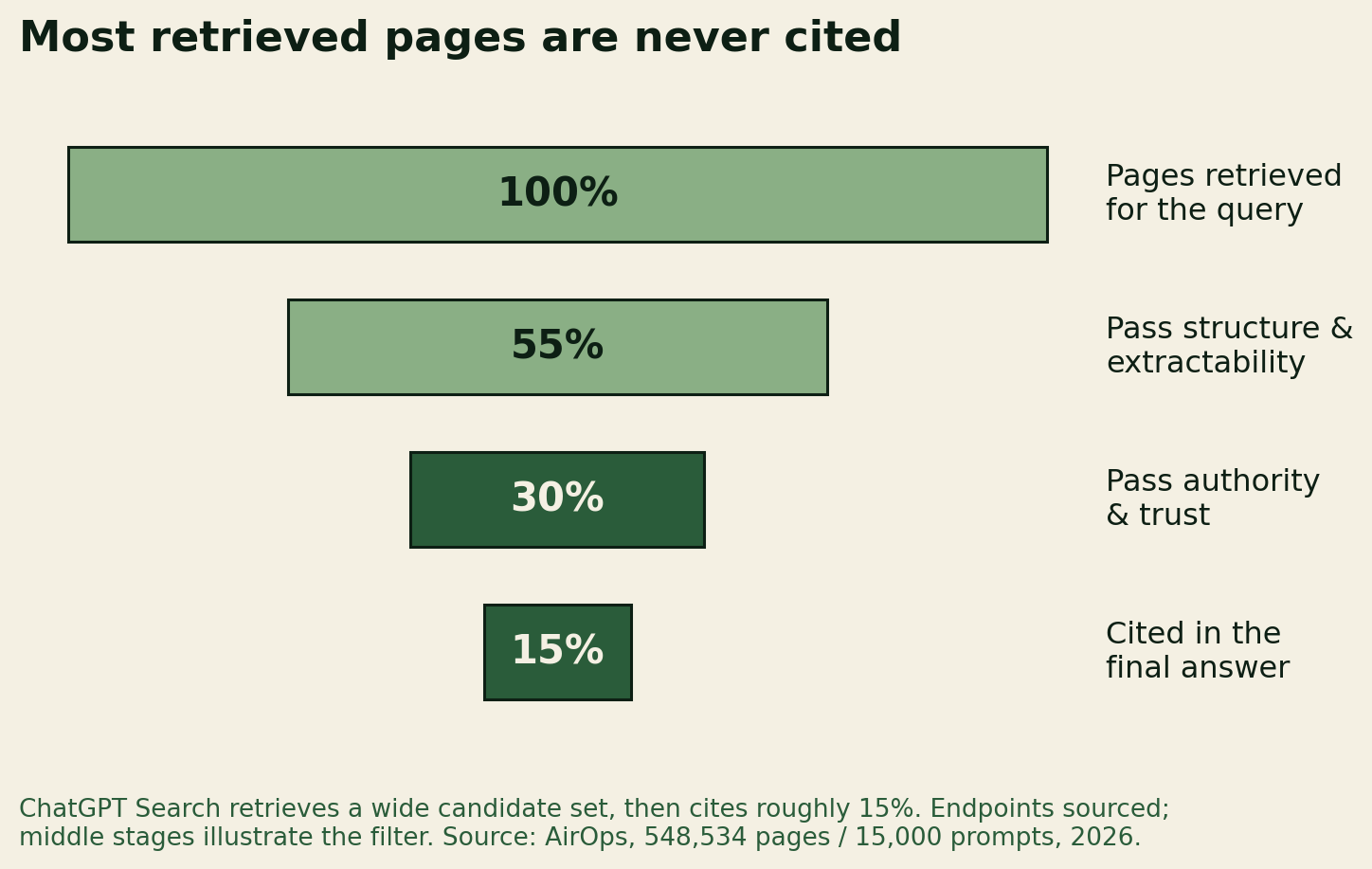
What survives: pages that front-load a direct answer, carry high fact density, and use FAQ-style structure. Structured content with FAQ schema has been measured at roughly 3x the citation rate of plain prose (Authoritas). There is also a trust threshold. Sites with very large referring-domain counts are cited several times more often than low-authority sites, which means earned media and third-party coverage matter as much as your own pages.
Gemini and Google AI Overviews (run on Google)
Gemini grounds its answers in a live Google search, then runs a multi-stage pipeline: it narrows a few hundred candidate documents down to a handful of citations, using E-E-A-T as a near pass/fail gate and Gemini re-ranking at the passage level. It also fans a single question out into several sub-queries, so a page that cleanly answers each sub-question earns more citation surfaces.
The decoupling from classic ranking is the headline. The share of AI-Overview citations that also rank in Google's organic top 10 fell from about 76% to 38% in roughly a year (ZipTie), and in Google's newer AI Mode, analysis found 88% of cited sources were not ranking on the organic results page at all (Moz, 2026). Ranking still helps, but it no longer guarantees the citation.
Claude (runs on Brave)
Claude's web search runs on Brave, with 86.7% of its citations overlapping Brave's organic results (Profound). Three things make it distinct. First, no preferred-publisher list and full respect for robots.txt, which levels the field. Second, a documented preference for content that is concise, current, and closely matched to how the user actually phrased the question. Third, direct fetch: when a user pastes a URL, Claude can read the full page into context and work from it, and its agentic Research mode chains multiple searches together, so the content it ends up citing can come from a longer retrieval path than a single query suggests.
For a niche B2B brand, this is the friendliest of the three. You do not need a massive backlink profile to be cited. You need genuine expertise, clean structure, and phrasing that matches your buyer's question.
How do you write content that AI engines cite?
Front-load the answer: 44.2% of AI citations come from the first 30% of a page, so put a 40 to 60 word direct answer at the top of each section. Then add fact density (numbers, dates, specifics), question-shaped headings, self-contained sections, FAQ and Article schema, and visible author and update dates. The same moves lift citation rates across all three engines.
Every engine above is doing the same core thing: scanning for a self-contained passage it can lift and attribute. That is the entire game. Content built to keep a human scrolling is the opposite of content built to be extracted.
The single highest-leverage move is front-loading. Across engines, 44.2% of AI citations are pulled from the first 30% of a page. Put the direct answer in the first 40 to 60 words of each section, then add the detail underneath.
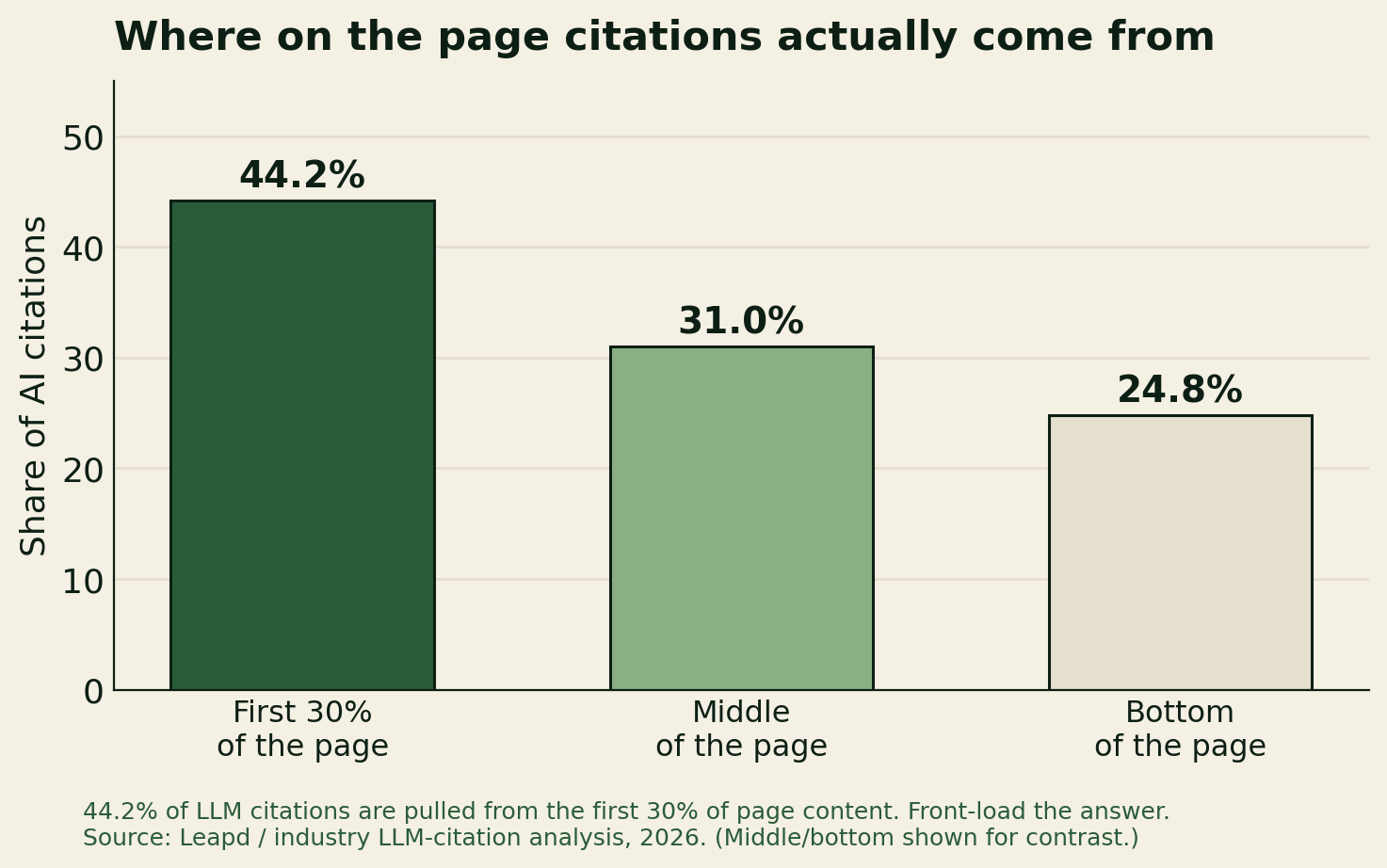
Structure compounds the effect. The same formatting moves that help one engine tend to help all of them, which is what makes a single audit worth doing.
- Answer capsules: a quotable 40 to 80 word block that directly answers one question, at the top of each section.
- High fact density: pages above roughly one fact per 80 words are measured at 4.2x the citation likelihood (Citegrade). Name the numbers, the dates, the specifics.
- Question-shaped headings: write H2s and H3s the way buyers ask, not the way org charts are drawn.
- Self-contained sections: each section should stand on its own, because engines extract single passages, not whole pages.
- Schema and freshness: FAQ, HowTo, Article, and Product schema plus visible author and update dates. Stale dates read as stale facts.
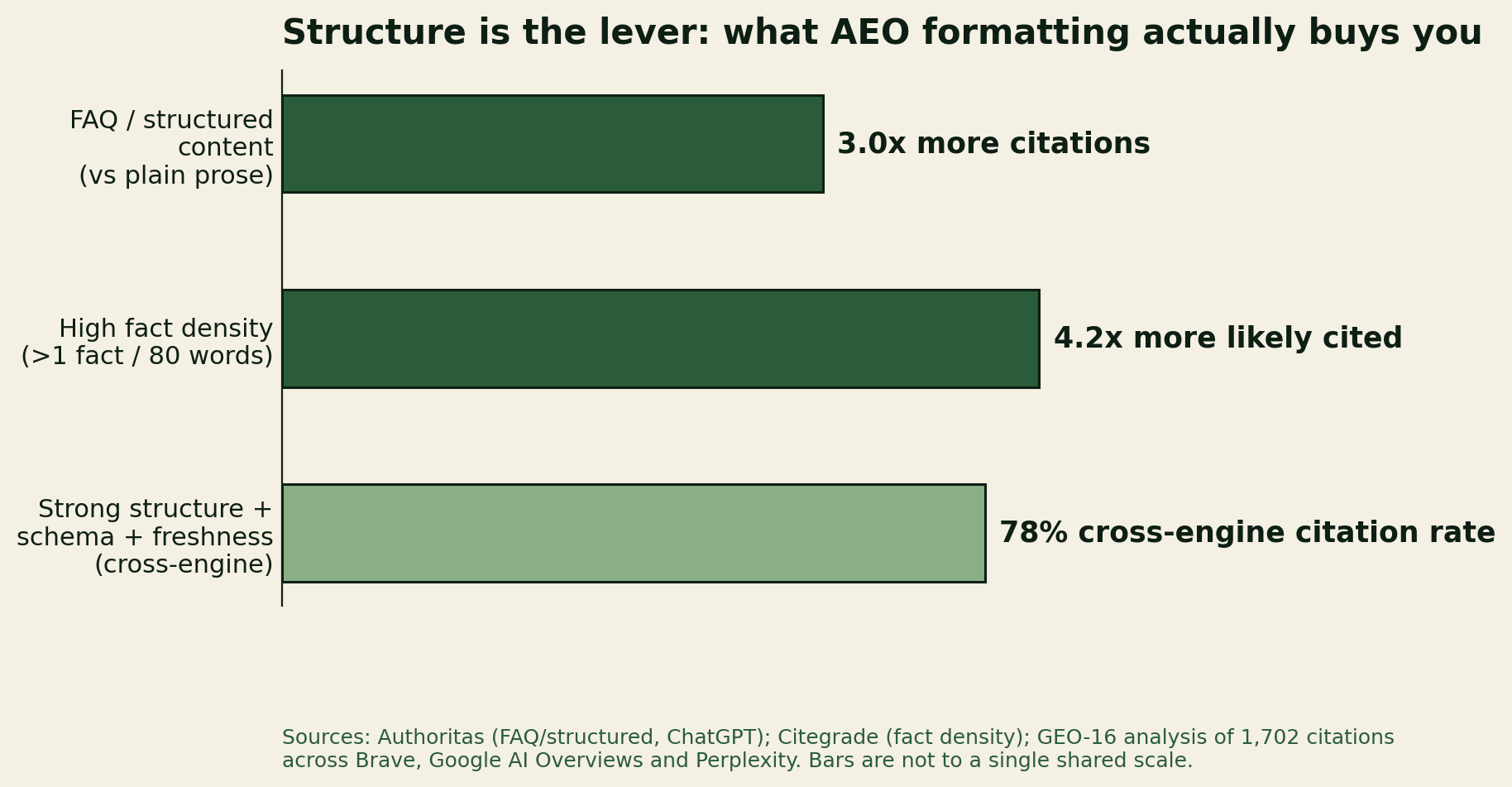
Why one audit covers three engines The retrieval backbones differ, but the content rules largely converge. A GEO-16 analysis of 1,702 citations across Brave, Google AI Overviews, and Perplexity found pages strong on semantic HTML, structured data, and freshness hit a 78% cross-engine citation rate. So you audit your content once, against the structural standard, and you lift visibility everywhere, including the engine HubSpot will not show you.
How do you audit content with HubSpot AEO?
HubSpot AEO gives you a baseline in four steps: define buyer prompts and check your visibility score across ChatGPT, Perplexity, and Gemini; run citation analysis to see which domains shape the answers; work the prioritized recommendations; track the score weekly. The dashboard tells you where you're absent. The page-level checklist below is what actually gets you cited.
HubSpot AEO is the fastest way to get a baseline. As of September 2026 it is $50/month standalone with no existing HubSpot subscription required, and it is included in Marketing Hub Pro and Enterprise. For a one-time snapshot, the free AEO Grader scores your recognition, sentiment, and competitive standing in a single report. The tool runs in four steps.
- Check your AI visibility score. Define the prompts your buyers actually ask, and HubSpot runs them across ChatGPT, Perplexity, and Gemini to show how often you appear and whether sentiment is positive, neutral, or negative. This is your baseline.
- Run citation analysis. See which domains, content types, and channels are shaping the answers in your category. If your competitors are getting cited and you are not, this tells you where it is coming from: their own pages, review sites, Reddit, or trade press.
- Take the prioritized recommendations. The tool generates a specific, ranked list of what to create or fix. In Marketing Hub Pro+, those recommendations are informed by your CRM data, so the prompts reflect your real buyers rather than generic category terms.
- Track the score week over week. AEO is not a one-time project. Watch the visibility score move as you ship fixes, and refine based on what actually shifts the needle.
What the dashboard will not do for you is the content-level audit. The score tells you that you are absent. It does not rewrite the page. Run every priority page against this checklist.
| Page element | What good looks like | Why it matters |
|---|---|---|
| Opening of each section | A direct 40 to 60 word answer to one specific question, before any setup. | 44.2% of citations come from the first 30% of the page. |
| Headings | Phrased as the question a buyer would ask the engine. | Engines match content to natural-language queries and sub-queries. |
| Fact density | Concrete numbers, dates, and named specifics throughout. | High fact density correlates with 4.2x citation likelihood. |
| Schema | FAQ, HowTo, Article, and Product markup, validated. | Structured data is a measured multiplier on citation rate. |
| Freshness signals | Visible author, publish date, and last-updated date. | Stale dates read as stale facts and suppress citations. |
| Off-page presence | Consistent mentions on LinkedIn, trade outlets, and forums. | Multi-source consensus is what builds trust with the engines. |
| Retrievability | Key content in real text, not locked in images, code, or pop-ups. | If a crawler cannot read it, no engine can cite it. |
What AEO metrics should you track?
Four metrics tell you whether AEO is working. Track all four, because the relationship between them is the diagnostic.
- Mentions: how often your brand appears in an answer, with or without a link.
- Citations: how often that mention includes a clickable source back to you.
- Share of voice: your mention rate against competitors on the same prompts.
- AI referral traffic: visitors actually arriving from answer engines, and how they convert.
Reading the gaps is where the value is:
- If mentions are up but citations are flat, the problem is structure and retrievability. The engine knows you exist but cannot find a clean passage to attribute. Fix the page, not the prompt list.
- If citations are up but referral traffic is low, you are tracking the wrong prompts. They do not match how your buyers actually search. Fix the prompt list, not the page.
Close the Claude gap by hand Because HubSpot AEO does not track Claude, add a manual spot-check to your cadence. Once a month, run your top buyer prompts directly in Claude and log whether you are mentioned, whether you are cited, and who is cited instead. It takes 20 minutes and covers the one major engine your dashboard is blind to.
AEO is an infrastructure problem
The brands that win in answer engines will not be the ones that publish the most. They will be the ones whose content is structured to be extracted, whose claims are dense and dated, whose presence is consistent across owned and earned channels, and who measure the right four numbers across every engine their buyers use, not just the three a dashboard happens to show.
That is not a campaign. It is infrastructure. It is the same thing we tell every team staring at a stalled funnel or a murky attribution model: the problem is rarely effort, and it is rarely the tool. It is the system around the work. AEO is simply the newest place that truth shows up.
Focus on what matters. Scale what works.
Frequently asked questions
What is answer engine optimization (AEO)?
The practice of improving how often and how accurately your business appears inside AI-generated answers from tools like ChatGPT, Gemini, Perplexity, and Claude. It builds on SEO rather than replacing it. Where SEO targets a ranked list and the click, AEO targets the citation: being the source an engine quotes when a buyer asks a question you should answer.
Does HubSpot AEO track Claude?
No. As of September 2026, HubSpot AEO tracks ChatGPT, Perplexity, and Gemini. Claude retrieves through Brave Search, applies no preferred-publisher list, and respects robots.txt, which makes it the most level of the major engines for a niche brand. Close the gap manually: once a month, run your top buyer prompts in Claude and log whether you're mentioned, cited, or replaced by a competitor.
What content structure gets cited most by AI engines?
A direct 40 to 60 word answer at the top of each section, question-shaped H2s, one concrete fact roughly every 80 words, sections that stand alone, FAQ and Article schema, and visible author and last-updated dates. In a 1,702-citation cross-engine analysis, pages strong on semantic HTML, structured data, and freshness reached a 78% citation rate. Structured FAQ content is measured at about 3x the citation rate of plain prose.
How should a HubSpot agency audit client content for AI search readiness?
Start with the pages that carry the client's core buyer questions, usually service pages and the three or four best-ranking posts. Score each against the checklist: front-loaded answer, question headings, fact density, schema, freshness signals, retrievability. Run the client's top prompts in ChatGPT, Gemini, and Claude and log who gets cited instead. Fix structure before writing anything new, and re-run the prompts monthly.
Sources and further reading
- HubSpot. AEO overview and the four-step optimization workflow: AEO guide, plus the free AEO Grader (2026).
- AirOps. The figure that ChatGPT cites about 15% of retrieved pages, from 548,534 pages across 15,000 prompts: The Influence of Retrieval, Fan-out, and Google SERPs on ChatGPT Citations (2026).
- Profound. The 86.7% overlap between Claude's citations and Brave's organic results: What Is Claude Web Search, Explained (2026).
- ZipTie. Google AI Overviews source selection and the decline in organic-ranking overlap: Reverse-engineering how AI Overviews picks sources (2026).
- Moz (Tom Capper). The finding that 88% of Google AI Mode citations sit outside the organic SERP, from a 40,000-query study, as reported by Search Engine Land (2026).
- Authoritas. FAQ and structured-content citation lift in ChatGPT, as reported by AI Boost (2026).
- Citegrade. Fact-density and citation likelihood (the 4.2x figure): How to Get Cited by ChatGPT (2026).
- Leapd. The 44.2% of citations drawn from the first 30% of a page: How ChatGPT, Google AI Overviews, and Perplexity source information (2026).
- GEO-16 (Wrodium Research). Cross-engine analysis of 1,702 citations across Brave, Google AI Overviews, and Perplexity (the 78% figure), as documented by Authority Tech (2025).
- Anthropic. How Claude retrieves and cites web sources: Web search tool documentation (2026).
Not sure whether AI search is quietly cutting you from your buyers' shortlist?
Focus+Scale audits your content for answer-engine readiness across ChatGPT, Gemini, and Claude, then builds the structure, schema, and measurement into HubSpot so your visibility compounds instead of guessing.
Get in Touch →