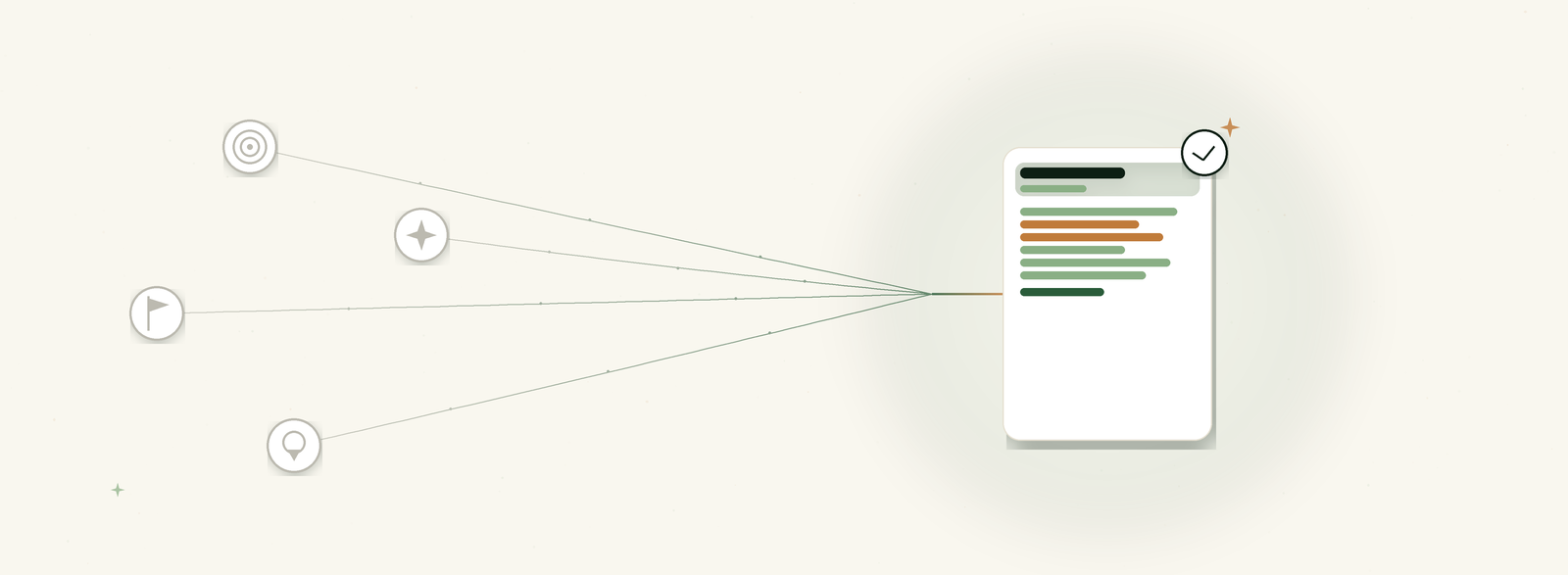
TL;DR Lead scoring, lifecycle stages, attribution, and data hygiene fail when run as four projects. They only work as one mechanism: every time a record crosses a stage boundary, the same five writes fire. Eligibility passes, stage advances, dates stamp, an immutable attribution snapshot writes, and routing fires. Build it once as a HubSpot workflow, clone it per milestone. A stage change missing any write is a hole in the funnel report.
Lead scoring, lead management, attribution, and data hygiene get run as four separate projects. A scoring model built by marketing ops. A lifecycle stage cleanup scheduled for next quarter. An attribution report requested by finance. A “data hygiene sprint” nobody has time for until the CRM gets bad enough to force it.
They only work as one system.
Scoring gates stage progression. Every stage change stamps attribution. None of it holds up without clean data underneath. Run these as four separate backlogs and you get four half-built systems that do not talk to each other: a scoring model sales does not trust, a lifecycle stage nobody can explain, an attribution report that contradicts the CRM, and a hygiene process that starts over every year because nothing upstream stopped the mess from recurring.
The fix is a single mechanism, built once and cloned per milestone, that fires every time a record crosses a stage boundary. Call it the transition contract.
What are the five writes in a lifecycle stage transition?
Every milestone (MQL, Sales Accepted, Connected, SQL, Opportunity, Closed Won) executes the same five writes: eligibility passes on explicit gates, never score alone; stage advances on the owning layer, forward only; native dates stamp; an immutable snapshot writes the attribution and qualification payload; and routing fires owner assignment, Lead creation, the SLA clock, and any enrollment. Skip one and the funnel report has a hole.
Every milestone a record can hit, MQL, Sales Accepted, Connected, SQL, Opportunity, Closed Won, executes the same five writes.
| # | Write | Mechanism in HubSpot |
|---|---|---|
| 1 | Eligibility passes | Explicit qualification gates confirmed, never score alone |
| 2 | Stage advances | On the owning layer (lifecycle or Lead pipeline), forward only |
| 3 | Dates stamp | Native date-entered, date-exited, time-in-stage; Lead object timestamps |
| 4 | Snapshot writes | Immutable milestone attribution and qualification payload |
| 5 | Routing fires | Owner assignment, Lead creation, SLA clock, nurture or sequence enrollment |
A stage change without all five writes is a hole in the funnel report. Not a small gap, a hole. Eligibility passes but the snapshot does not write, and you have a record in SQL with no record of what qualified it. The stage advances but routing does not fire, and you have an MQL sitting unowned, invisible to the SLA dashboard because nothing started the clock. Every one of these failure modes looks the same downstream: a report that does not match what the sales team is actually working, and nobody can say why.
The infrastructure read Most teams diagnose a broken funnel report as a data problem, or worse, an effort problem. It is neither. It is what happens when scoring, stage, and attribution were never wired to move together as one mechanism. Build the contract once as a workflow pattern and clone it per milestone. Do not rebuild the logic from scratch each time a new stage gets added, that is how six similar-but-slightly-different workflows end up governing six stages, each with its own quiet bug that surfaces three months later as a funnel number nobody can reconcile.
Why do lead scoring, lifecycle, and attribution fail as separate projects?
Picture the more common build. Marketing ops stands up a scoring model in isolation, tuned against last year’s conversion data. A separate project cleans up lifecycle stages, because someone noticed Contacts sitting in MQL for eight months. Finance commissions an attribution report on its own timeline, pulling from whatever source fields happen to be populated. Data hygiene gets a sprint whenever the duplicate count gets embarrassing enough to complain about in a leadership meeting.
Each project ships. Each one looks finished in isolation. None of them reference each other, because none of them were scoped to.
Three months later, the scoring model is technically live but nothing consumes its output, because the lifecycle workflow that was supposed to gate on it still checks a different, older property. The attribution report shows a spike in organic traffic that does not match what marketing ran, because the snapshot properties it pulls from were never wired to fire on stage change, so they are stale or blank for anything created in the last two quarters. The hygiene sprint dedupes ten thousand records, and the duplicate rate climbs right back within six months, because nothing upstream stopped new duplicates from forming. Every one of these is a real, billable, well-executed project. None of them fixes the funnel, because the funnel was never the sum of four projects. It is one system with four surfaces.
Five principles that make the contract hold
1. Scoring informs, it does not decide
Lead scoring feeds stage progression. It never acts alone. Thresholds combine with explicit gates: ICP fit, buying role, geography, valid contact information, high-intent behavior. A record that clears the score threshold but fails a gate does not advance. This is the difference between a scoring model sales trusts and one they route around. If reps discover the model auto-promotes obvious non-fits because the score alone was sufficient, they stop reading MQL as a signal within a month, and every hour spent tuning the model afterward is wasted.
2. Three layers, three jobs
Lifecycle Stage, Lead pipeline stage, and Lead Status are not interchangeable, and treating them that way is the single most common build mistake I see.
Lifecycle Stage is the macro funnel position, tracked on Contacts and Companies: Known, Lead, MQL, SQL, Opportunity, Customer. It is forward-only. The Lead pipeline is current prospecting activity: New, Attempting, Connected, Qualified or Disqualified. It lives on the Lead object and resets with every new pursuit. Lead Status is a legacy sub-status, relevant only where the Lead object is not in use or a legacy integration requires it.
For the full breakdown of lifecycle stage and lead status, see The Definitive Guide to HubSpot Lifecycle Stages.
The most common build mistake Sales Accepted and Connected belong on the Lead pipeline. They are not lifecycle stages. Build them as custom lifecycle values and you break forward-only reporting the first time a rejected lead needs to be reworked, because lifecycle cannot step backward and a second attempt at the same contact has nowhere to go. Lifecycle jumps MQL to SQL. The Lead record carries the working detail in between.
The Lead pipeline is also where the acceptance SLA lives, and it is worth building deliberately instead of leaving implicit. Route immediately after MQL creation and require an owner assignment as part of routing, not as a separate manual step. First touch within one business hour is a reasonable default, and Time to First Touch is native on the Lead object, so there is no reason to build a custom timestamp for it. Accept or reject within one business day, with a reason pulled from the same controlled picklist referenced below. A Lead with no activity and no next step past that window is not a data problem, it is a process problem, and it should escalate automatically rather than wait for someone to notice.
3. Attribution is captured at entry, never overwritten
Preserve Original and Latest Traffic Source separately. Write an immutable snapshot at every milestone: MQL, Sales Accepted, Connected, SQL, Opportunity, Closed Won. Lock each snapshot once it writes. The temptation is to let a stage-entry property keep updating as new information arrives, treating it as a live field instead of a record. Resist it. The value of a snapshot is that it tells you what was true the moment the record crossed the line, and that only holds if nothing downstream is allowed to touch it.
4. A stage is a milestone, not a task list
Every stage needs entry criteria, exit criteria, recycle criteria, and disqualification criteria, defined before the stage goes live. A stage represents an achieved business milestone, something the buyer did or confirmed, not an activity marketing or sales completed. “Sent five emails” is not a milestone. “Booked a qualified meeting” is. If you cannot write a one-sentence entry criterion for a stage that describes what the record did to earn it, the stage is not ready to build.
This is also where recycle and disqualification criteria earn their keep. A Lead that gets rejected needs a reason from one controlled picklist, shared across MQL rejection and Lead disqualification, so the same “no response” or “bad timing” language means the same thing everywhere it appears. Without a shared list, one rep’s “not interested” and another’s “no budget” get treated as different outcomes in reporting when they were the same disposition, and quarterly calibration ends up comparing categories that were never actually comparable.
5. One property, one job, one owner
Company, Contact, Lead, and Deal each own a distinct slice of the data, and none of them duplicate what another owns.
| Object | Owns | Never stores |
|---|---|---|
| Company | Account fit score, ICP tier, target-account flag, account lifecycle (synced via associations), territory, owner | Person-level engagement detail |
| Contact | Person fit, consent, buying role, engagement score, lifecycle stage, Original and Latest Source, milestone snapshots | Account-wide qualification data |
| Lead | The active pursuit: pipeline stage, outreach outcomes, DQ reason, owner-assigned date, first outreach, time to first touch | Long-term identity data, which lives on the Contact |
| Deal | The opportunity: pipeline stage, amount, close date, loss reason | Pre-pipeline working states |
Buying roles live on association labels, not on a Contact property that tries to describe a role relative to a specific deal. A new pursuit of a previously worked contact gets a new Lead record, not a recycled status on the old one. This matters more than it sounds like it should. The instant a team starts reusing objects to save a field or skip a record creation, the object model stops being trustworthy, and every report built on top of it inherits the ambiguity.
How do you build a transition contract as a HubSpot workflow?
One workflow per milestone, six actions, five writes. Trigger on score threshold plus eligibility gates. Branch on eligibility, with overrides handled in the same branch and failures exiting to nurture. Set the lifecycle stage as the only property touched. Let native date-entered and time-in-stage do their job. Write the snapshot as one batch action and never touch it again. Fire routing. Clone the pattern for every other milestone.
Here is how the five writes map onto an actual HubSpot workflow for a single milestone, using MQL as the example.
Trigger. Enrollment criteria combine the score threshold with the eligibility gates: ICP tier is not “unqualified,” buying role is populated, geography is supported, email is not a hard bounce. The workflow does not enroll on score alone.
Branch on eligibility. A single IF/THEN branch confirms every gate before anything else fires. Records that fail the branch exit into a nurture path, not into MQL. This is write one, made explicit instead of assumed.
Handle overrides in the same branch, not as a separate workflow. A demo request, a contact-sales form, a qualified meeting booked, or an explicit pricing request can bypass the score threshold, but minimum eligibility still applies: supported geography, valid identity, a plausible use case. Build the override as a second path into the same branch, gated by its own hard checks, so a demo request from an unsupported region still exits to nurture instead of skipping every gate because a rep or a form treated “high intent” as “immune to disqualification.” The moment overrides live in a separate, less-guarded workflow, they become the way low-fit records slip into MQL and quietly erode trust in the model.
Advance the stage. Set Lifecycle Stage to MQL on the Contact. This is the owning layer for this milestone, forward-only, and it is the only property this action touches. Do not also set a Lead pipeline stage here. That comes later, when Sales Accepts.
Let the native dates do their job. HubSpot stamps date-entered, date-exited, and time-in-stage automatically on lifecycle stage changes. Do not build a custom workflow action to replicate what the platform already gives you. The only date property you need to set manually is Latest MQL Date, because that one has to survive recycling.
Write the snapshot. A single “Set property” batch action on the Contact, timed to fire in the same enrollment as the stage change, writes: entry date, source, medium, campaign and campaign ID, triggering conversion and asset, Contact and Company scores, qualification band, record owner, and an attribution-confidence class (tracked conversion, offline import, or manually set). This batch is copied from Latest Traffic Source and current score properties at the moment of enrollment, then never touched again by any other workflow. That is what makes it a snapshot instead of a live field.
Fire routing. Assign the owner, create the Lead record at this lifecycle stage, and start the Time to First Touch clock, which is native on the Lead object. If a sequence or nurture track applies before human outreach, enroll it here, not in a separate workflow that might fire out of order.
Six actions, five writes, one workflow. Clone this pattern for Sales Accepted, Connected, SQL, Opportunity, and Closed Won, swapping the trigger and the target properties for each. The branch logic, the snapshot discipline, and the routing sequence stay identical. That consistency is what makes the funnel report trustworthy across every stage instead of trustworthy in the two stages someone remembered to build carefully.
How do you tell when a transition contract is broken?
You don't need to audit every workflow. The symptoms show up in the data: MQLs with no Lead record, qualified Leads with no Deal, Deals with no primary Contact, unclassified sources on records past MQL, and stage aging that doesn't match reality. Each one maps to exactly one missing write, so you fix that write without touching the four that work.
You do not need to audit every workflow to find where the contract is broken. The symptoms show up in the data:
- MQLs without Leads. Stage advanced, routing did not fire. Somebody is sitting in MQL with no owner and no SLA clock.
- Qualified Leads without Deals. Exit criteria fired without the downstream object getting created. The Lead pipeline says Qualified; the Deal pipeline has never heard of it.
- Deals without primary Contacts. The object model broke down somewhere upstream, usually because a Deal got created manually to route around a stuck workflow.
- Unclassified sources on records past MQL. The snapshot write either did not fire or fired against blank Latest Source properties, usually because a form did not have UTM capture wired in.
- Stage aging that does not match reality. Native date-entered is blank or wrong, which means someone updated the lifecycle stage property directly instead of letting the workflow do it, and the transition contract never ran at all.
Each of these is diagnosable by checking which of the five writes did not happen, not by re-litigating the whole system. That is the payoff of building it as a named contract instead of an ad hoc set of workflows: when something breaks, you know exactly which write to check first, and you can fix that one write without touching the four that are working.
How often should you review lead scoring and lifecycle stages?
The contract is not a one-time build. It needs a rhythm to stay honest.
| Cadence | What to check |
|---|---|
| Daily | No MQL sits unowned or without a disposition clock; escalate any Lead with no next activity |
| Weekly | Data-quality digest, merge queue, SLA dashboard: time to first touch, acceptance rate, stage aging |
| Monthly | Score performance against acceptance and rejection reasons; funnel conversion by stage; snapshot attribution review |
| Quarterly | Full scoring calibration against outcomes; property audit; disqualification reason analysis; attribution model comparison |
Marketing owns the scoring model. Sales signs the MQL definition and validates it in the field. Neither side gets to unilaterally change a threshold or a gate without the other seeing it, because the contract only holds if both teams are reading the same five writes off the same records.
Most revenue problems get diagnosed as a tool problem or an effort problem. Buy a better attribution add-on. Push the team to work leads faster. Run another training on the scoring model. Almost none of that addresses the actual gap, which is that the system was never built to write the same five things, the same way, every time a record crosses a line. Fix that once, and the scoring model, the lifecycle stages, the attribution report, and the data hygiene all start holding each other up instead of drifting apart.
Focus on what matters. Scale what works.
Frequently asked questions
What is a transition contract in HubSpot?
A single workflow pattern that fires the same five writes every time a record crosses a lifecycle or pipeline milestone: eligibility check, stage advance, date stamps, an immutable attribution snapshot, and routing. It's built once, then cloned per milestone (MQL, Sales Accepted, Connected, SQL, Opportunity, Closed Won) so scoring, lifecycle stages, attribution, and data hygiene move together instead of drifting apart as four separate projects.
Should lead score alone move a contact to MQL?
No. Score informs, it doesn't decide. A threshold combines with explicit gates: ICP fit, buying role, supported geography, valid contact information, high-intent behavior. A record that clears the score but fails a gate goes to nurture, not MQL. High-intent overrides like demo requests can bypass the score but not the minimum gates. The moment score alone promotes obvious non-fits, sales stops reading MQL as a signal.
How do you keep HubSpot attribution snapshots from being overwritten?
Write the snapshot as one batch “Set property” action in the same workflow enrollment as the stage change, copying Latest Traffic Source, campaign, conversion asset, scores, owner, and an attribution-confidence class at that moment. Then make sure no other workflow writes to those properties. Keep Original and Latest Traffic Source separate. A snapshot records what was true when the line was crossed, and it's only useful if it can't change afterward.
How should a B2B RevOps team set an MQL acceptance SLA in HubSpot?
Route immediately after MQL creation and require owner assignment as part of routing, not as a separate manual step. First touch within one business hour is a reasonable default, and Time to First Touch is native on the Lead object. Accept or reject within one business day with a reason from a controlled picklist shared with disqualification. A Lead with no activity past that window escalates automatically.
Not sure your funnel report reflects what is actually happening in your pipeline?
Focus+Scale audits lead scoring, lifecycle stages, and attribution in HubSpot, then builds the transition contract into your workflows so every number your team reports can be trusted.
Get in Touch →