

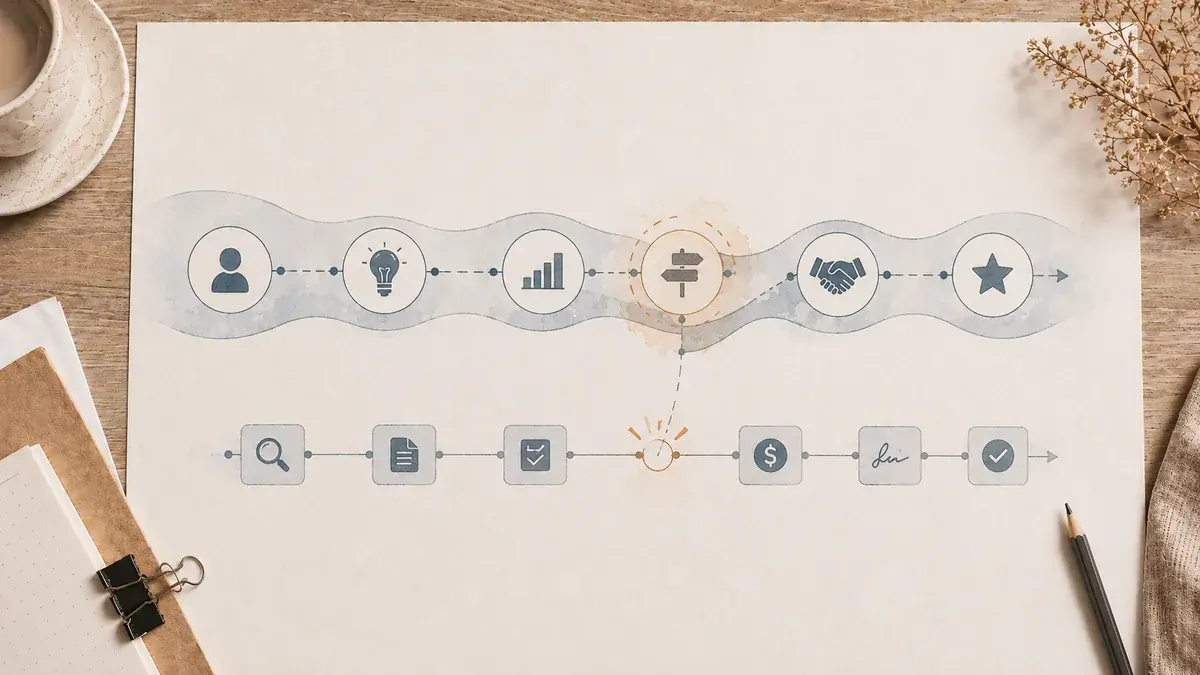
TL;DR Lifecycle stage is a contact property that tracks the whole relationship, forward only. Deal stage is a deal property that tracks one transaction through the pipeline. Confusing them breaks funnel reports and handoff timing. Wire them so deals set lifecycle forward automatically, never backward, and use Lead Status for what sales is doing right now.
Why do lifecycle stage and deal stage get confused?
HubSpot has a lifecycle stage property on contacts and companies. It also has a deal stage property on deals. Both use the word "stage." Both track progression. And in almost every portal audit we run, they're being used interchangeably, or worse, one is being ignored entirely.
The confusion creates real operational damage. Marketing builds funnel reports using lifecycle stages, but the stages are being set by deal progression instead of contact behavior. Sales creates deals before the contact is actually qualified, which pushes lifecycle stage to Opportunity prematurely. Leadership looks at a funnel dashboard and sees numbers that don't reconcile with closed revenue.
The root cause is definitional. Nobody mapped out which property answers which question.
Lifecycle stage answers: "What is this contact's relationship with our business?" Deal stage answers: "Where is this specific transaction in our sales process?"
What does lifecycle stage track?
Lifecycle stage is a contact and company property that tracks the overall relationship across a person's whole history, independent of any single deal: Subscriber, Lead, MQL, SQL, Opportunity, Customer, Evangelist, Other. It ramps up incrementally and by best practice never resets. A customer who re-engages is still a customer; Lead Status or a custom property carries the operational detail.
Lifecycle stage is a contact and company property. It tracks the overall relationship a person has with your organization across their entire history, not tied to any single deal. It moves forward incrementally and, by best practice, should never move backward.
Default Stages and What They Mean
- Subscriber: Opted in to content (newsletter, blog). Lightest engagement.
- Lead: Converted beyond subscription. Form fill, content download, some interaction beyond passive consumption.
- MQL: Marketing has qualified this contact as engaged enough to warrant sales attention. Usually set by lead scoring threshold or high-intent action.
- SQL: Sales has reviewed and accepted this lead as worth pursuing. One-on-one interaction has occurred.
- Opportunity: An active deal exists. Contact is associated with an open deal record.
- Customer: At least one deal has closed won.
- Evangelist: A customer who actively advocates (optional, often unused).
- Other: Contacts that don't fit the funnel: partners, vendors, competitors.
The key principle: lifecycle stage should ramp up incrementally and not be reset. A customer who re-engages doesn't become a lead again. They're still a customer. Their Lead Status or a custom re-engagement property handles the operational detail.
What does deal stage track?
Deal stage is a deal property that tracks one specific transaction through the pipeline, from Appointment Scheduled to Closed Won or Closed Lost, each stage carrying a win probability. One contact can have several deals at different stages while their lifecycle stage stays put. Stages should map to your real sales process, and fundamentally different tracks belong in separate pipelines.
Deal stage is a deal property. It tracks the progression of a single, specific sales transaction through your pipeline. One contact can have multiple deals simultaneously, each at different deal stages, while their lifecycle stage remains static.
How Deal Stages Typically Map
- Appointment Scheduled (20%): Initial meeting booked with the prospect.
- Qualified to Buy (30%): Discovery complete, confirmed fit and budget.
- Presentation Scheduled (40%): Demo or proposal presentation arranged.
- Contract Sent (60%): Formal proposal or contract delivered.
- Contract Negotiation (80%): Terms under discussion.
- Closed Won (100%): Deal signed and revenue recognized.
- Closed Lost (0%): Opportunity did not convert.
Deal stages are fully customizable and should map to your actual sales process, not HubSpot's defaults. If your sales process has fundamentally different tracks (enterprise vs. SMB, new business vs. upsell), those should be separate pipelines with their own stage definitions.
What are the most common lifecycle and deal stage mistakes?
1. Creating Deals Too Early
Sales creates a deal at first contact, pushing the lifecycle stage to Opportunity before the contact has been qualified. This inflates the Opportunity count in funnel reports and makes your MQL→SQL→Opportunity conversion rates meaningless. Deals should be created when a legitimate sales opportunity has been identified, not when a rep wants to "track" a conversation.
2. Using Deal Stage as a Proxy for Lifecycle Stage
Teams skip lifecycle stages entirely and rely on deal stage to indicate where a contact is in the journey. This breaks marketing's ability to segment and report on funnel progression, because deal stage is a deal property, not a contact property. You can't build a contact list based on deal stage without association filters, and those filters are fragile.
3. Moving Lifecycle Stage Backward
A deal closes lost, and a workflow resets the contact's lifecycle stage back to Lead or MQL. This destroys historical funnel data, breaks lifecycle stage date properties (Became a Customer Date gets cleared), and makes re-engagement reporting impossible. If a deal closes lost, update Lead Status, not lifecycle stage.
How should lifecycle stage and deal stage work together?
Automate lifecycle stage forward only: score threshold to MQL, sales acceptance to SQL, deal creation to Opportunity, closed-won to Customer, using HubSpot's built-in Automate settings for the last two. Track sales disposition in Lead Status, not lifecycle. When a deal closes lost, lifecycle stays where it is, Lead Status moves to Bad Timing or Nurture, and the engagement score resets.
Lifecycle stage and deal stage are complementary. They answer different questions at different levels of granularity. Here's how to wire them so they reinforce each other without creating conflicts.
Forward-Only Lifecycle Stage Automation
- Lead → MQL: Set by lead scoring threshold or high-intent form submission (demo request, pricing inquiry).
- MQL → SQL: Set by sales accepting the lead (manual update to Lead Status = "Connected" or "Qualified" triggers workflow).
- SQL → Opportunity: Set automatically when a deal is created and associated with the contact.
- Opportunity → Customer: Set automatically when any associated deal moves to Closed Won.
Use HubSpot's built-in setting for the last two: Settings → Objects → Contacts → Lifecycle Stage → Automate tab. Enable "Set lifecycle stage when a deal is created" and "Set lifecycle stage when a deal is won."
Lead Status for the Operational Detail
Lead Status is a sub-property that lives within the SQL lifecycle stage and gives sales the granular tracking they need without touching lifecycle stage. Common values: New, Attempting Contact, Connected, Qualified, Unqualified, Bad Timing, Nurture. This is where you track sales disposition, not by moving lifecycle stage backward.
What Happens When a Deal Closes Lost?
- Lifecycle stage stays at Opportunity (or Customer if they've previously purchased). Never moves backward.
- Lead Status updates to "Bad Timing" or "Nurture" or a custom value that marketing can use for re-engagement segmentation.
- If using lead scoring, reset the engagement score so they can re-qualify through future behavior.
How do you report on lifecycle stage and deal stage separately?
With lifecycle stage and deal stage properly separated, you unlock two distinct reporting dimensions:
Lifecycle stage reporting: Funnel conversion rates (Lead → MQL → SQL → Opportunity → Customer), time-in-stage metrics via calculated properties, and marketing attribution. This is the marketing performance view.
Deal stage reporting: Pipeline velocity, stage-to-stage conversion, weighted pipeline value, and sales forecasting. This is the sales performance view.
The calculated properties HubSpot provides automatically ("Became a Marketing Qualified Lead Date," "Became an Opportunity Date," and so on) only work if lifecycle stage moves forward cleanly. Every time you reset a lifecycle stage backward, you lose the date stamp and the ability to calculate time between stages.
Lifecycle stages are your funnel. Deal stages are your pipeline. The funnel tells you how marketing is performing. The pipeline tells you how sales is performing. Conflate them and you can't measure either.
Frequently asked questions
What is the difference between lifecycle stage and deal stage in HubSpot?
Lifecycle stage is a contact/company property that tracks the overall relationship with your business (subscriber through customer). Deal stage is a deal property that tracks the progression of a specific sales transaction through your pipeline. A contact has one lifecycle stage but can have multiple deals at different deal stages simultaneously.
Should lifecycle stage ever move backward?
No. Lifecycle stage should move forward only. If a deal closes lost, update the Lead Status property instead. Moving lifecycle stage backward destroys historical date properties, breaks funnel reporting, and makes re-engagement segmentation unreliable.
When should I create a deal in HubSpot?
Create a deal when a legitimate, qualified sales opportunity exists, not when a rep first contacts a lead. Premature deal creation inflates your pipeline, pushes lifecycle stage to Opportunity too early, and makes funnel conversion rates unreliable.
How do lifecycle stage and Lead Status work together?
Lead Status provides granular tracking within the SQL lifecycle stage. While lifecycle stage tells you the macro relationship (this contact is sales-qualified), Lead Status tells you the operational detail (New, Attempting Contact, Connected, Qualified, Unqualified, Bad Timing). Sales updates Lead Status; lifecycle stage is managed by automation.
Can a contact be a Customer and still have an open deal?
Yes. A contact who has previously purchased (lifecycle stage = Customer) can have new deals in progress. Their lifecycle stage stays Customer. The new deal tracks separately through deal stages.
Are your lifecycle stages and deal stages fighting each other?
We untangle the configuration, build forward-only automation, and get your funnel and pipeline reporting telling the truth again.
Let's Fix It →