

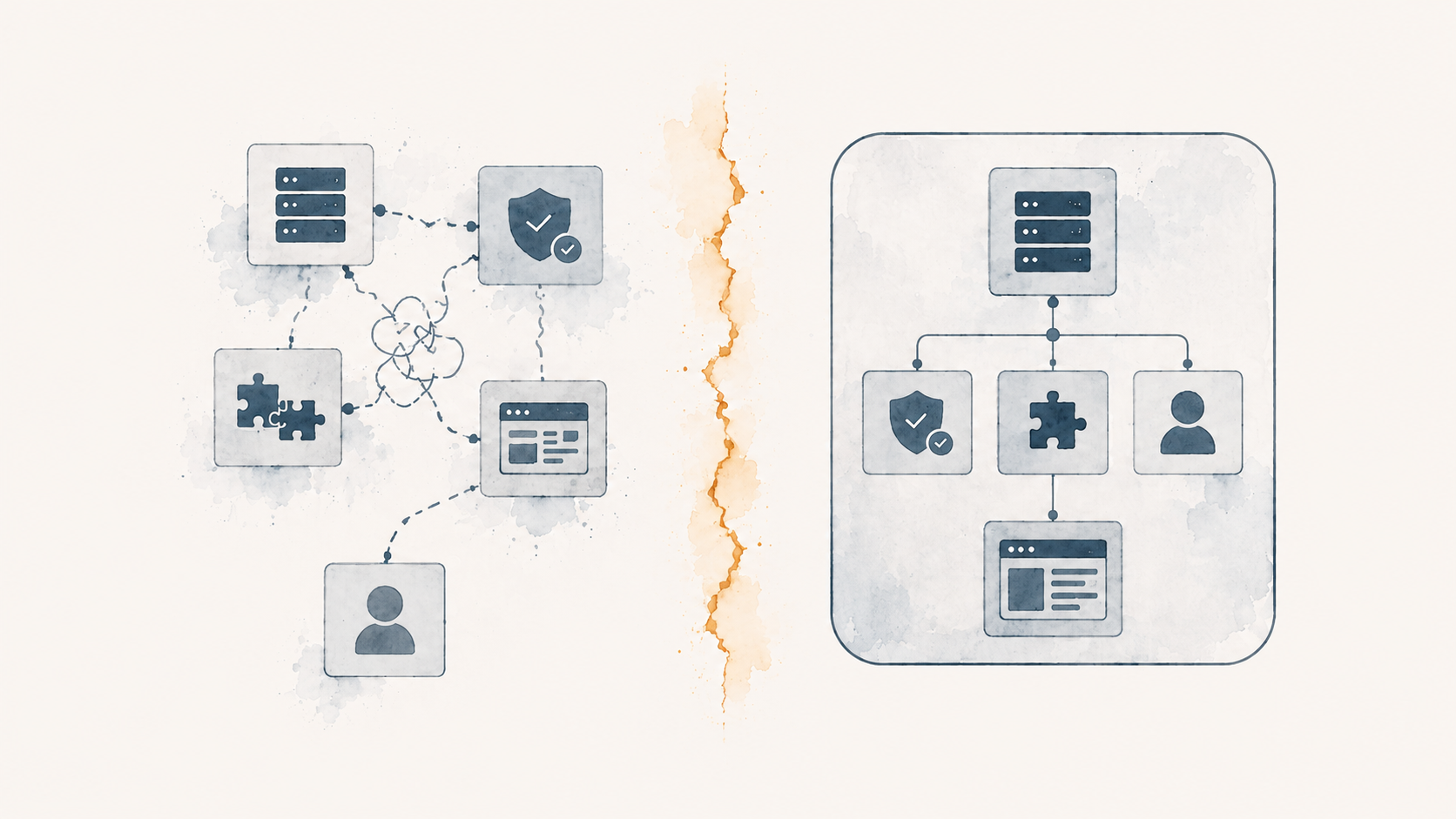
TL;DR For HubSpot users, the real cost of a WordPress site isn't hosting. It's the gap between website data and CRM data: page visits that never reach the contact record, attribution pieced together from UTMs, and maintenance nobody budgets for. Moving the site into HubSpot Content Hub closes that gap. It's the right move when the site's job is marketing and lead generation, not specialized functionality.
Most companies don't know what their WordPress site is really costing them. Not the hosting bill. Not the annual theme license. The real cost, the one nobody budgets for, is the gap between your website and your CRM.
Every form fill that doesn't sync cleanly. Every contact record missing the page visit history that would tell you what they actually care about. Every campaign where you're guessing at attribution because your website data and your HubSpot data live in two separate systems that were never designed to talk to each other.
That gap is where reporting breaks. And for HubSpot users running their site on WordPress, it's almost always there.
What does a WordPress site actually cost a HubSpot user?
Three costs, only one of which shows up on an invoice. Hosting, licenses, and developer time for patches and outages. The maintenance nobody owns. And the biggest: data fragmentation, where page visits, content engagement, and return sessions never reach the HubSpot contact record, so attribution gets pieced together from UTMs and form fills instead of observed.
WordPress is a capable platform. For organizations that need it, complex custom functionality, highly specific design requirements, deep plugin integrations, it earns its place. But for a significant number of HubSpot users, WordPress is just what the website has always been on. Nobody made a deliberate choice. It's just there, running in the background, requiring maintenance that nobody loves doing and costing money that doesn't show up as a line item anywhere obvious.
The maintenance overhead is real and consistently underestimated. Hosting. Security patches. Plugin updates. The plugin that broke after the last WordPress core update. The developer you had to call because the site went down the week before a big campaign. The SSL certificate that expired at an inconvenient moment. These aren't catastrophic events. They're slow, recurring friction that consumes time and budget without producing anything.
But the bigger cost is the data fragmentation. When your website and your CRM are separate systems, you're always working with an incomplete picture. You can see that a contact filled out a form. You can see that they came from a Google ad. What you often can't see, not cleanly, not reliably, is that they visited your pricing page three times before filling out the form, read two blog posts, came back a week later through organic search, and then converted.
That's the story that tells you what's working. And it lives in the gap between two platforms that weren't built to share it.
HubSpot users who move their site into Content Hub don't just eliminate the maintenance overhead. They close that gap entirely.
What changes when your website lives in HubSpot?
A contact's whole journey, from first page visit to closed deal, sits in one record. Attribution reports show what happened rather than what you could reconstruct. Campaigns connect by default instead of by integration. For agencies, that's the difference in what you can show a client. For nonprofits, it's seeing a prospect's four visits to the impact page next to their giving history.
When your website, CRM, blog, landing pages, and forms all live in the same system, the data stops fragmenting. A contact's entire journey, from first page visit to closed deal, is visible in a single record. Attribution reports reflect what actually happened, not what you can piece together from UTM parameters and form submissions. Campaigns become easier to build and easier to measure because everything is connected by default, not by integration.
For agencies managing client portals, this matters even more. The reporting you can produce for a client whose site is in HubSpot, where you can show the complete path from a blog post to a contact to a closed deal, is categorically different from what you can produce when the website is elsewhere. That difference shows up in retainer conversations.
For nonprofits, it shows up in donor reporting. Knowing that a major donor prospect visited your impact page four times before making their first gift, and being able to see that in the same place where you track their giving history, changes how you approach the relationship.
The case for simplicity that nobody makes loudly enough
Here's the more contrarian argument, and I think it's the right one. Most websites are more complicated than they need to be. Not in a technical sense, in a strategic one. They have fifteen pages when five would do. They have animations and interactions that required weeks of development and that nobody notices after the first visit. They were built to impress prospects in a proposal meeting rather than to convert visitors into leads. They look beautiful in a portfolio and perform mediocrely in practice.
The question that rarely gets asked before a website build: what does this site actually need to do?
For most B2B companies and nonprofits, the honest answer is: tell a credible story, surface the right content for the right audience, capture leads, and connect those leads to a CRM so the follow-up can happen. That's it.
A well-built HubSpot website with a solid blog and campaign-specific landing pages covers that ground completely, and does it in a system you already own, connected to the data you already care about.
A simpler site that you can actually maintain, update, and measure is almost always more valuable than a complex one that requires a specialist every time something needs to change.
When is moving WordPress to HubSpot the wrong call?
The honest version of this argument acknowledges the limits.
HubSpot Content Hub has a cost. At the professional and enterprise tiers, it's a real budget line, and for very small organizations, the economics don't always favor consolidation. Run the numbers.
Design-led sites belong on Webflow, not WordPress. If your website is a primary brand differentiator and its job is design and storytelling more than lead capture, HubSpot isn't the only managed platform. Webflow gives you full design control on managed hosting with no CRM subscription attached to the site. We lay out both paths in the two good ways off WordPress. Staying on WordPress is only the right call with real developer capacity, plugin discipline, and someone's name on the maintenance.
The migration itself requires investment. Moving a WordPress site to HubSpot isn't a trivial afternoon project. Content needs to migrate. Templates need to be built or adapted. Redirects need to be set up carefully so you don't lose the SEO equity you've built. Done well, the migration pays for itself quickly. Done carelessly, it creates a different set of problems.
But for HubSpot users who are running a WordPress site primarily out of inertia, where the site's job is marketing and lead generation, not specialized functionality, the consolidation case is strong. The maintenance savings are real. The attribution improvement is significant. And the simplicity argument, honestly applied, usually reveals that the site you need is less complicated than the one you have.
How do you decide whether to move your site from WordPress to HubSpot?
If you're a HubSpot user currently on WordPress and this is resonating, the first question to ask isn't "should we migrate?" It's "what is our site actually supposed to do, and is it doing it?"
Audit the site against its actual job. If the answer is marketing and lead generation, price out the consolidation. Factor in what you're currently spending on hosting, maintenance, and developer time. Compare that against Content Hub at the tier you'd need. Then look at what you'd gain in attribution and reporting.
In most cases, the math is closer than people expect. And the operational simplicity is worth something the spreadsheet doesn't fully capture.
Frequently asked questions
What is HubSpot Content Hub?
HubSpot's website and content platform: hosting, page builder, blog, landing pages, forms, and SEO tooling inside the same system as the CRM. Because forms and page tracking write straight to contact records, the site's data and the CRM's data are the same data. It's fully managed, so hosting, updates, and security are HubSpot's job rather than a plugin stack's.
How much does it cost to move a WordPress site to HubSpot?
Two lines. The platform: Content Hub at the Professional or Enterprise tier, priced monthly. The migration: content transfer, template build or adaptation, and redirect mapping, priced as a project and scaled by page count and design complexity. Compare the total against current hosting, maintenance, and developer time, then add what better attribution is worth. For small organizations the math can go either way. Run it.
How does moving a website into HubSpot improve attribution reporting?
Page visits, content engagement, and return sessions are recorded on the contact record automatically, because the website and CRM share one tracking layer. Attribution reports then reflect the observed path from first visit to closed deal, not a reconstruction from UTM parameters and form submissions. Original Source, multi-touch models, and campaign reports all get more complete without added integration work.
Should an agency move client websites from WordPress to HubSpot?
When the client's site exists for marketing and lead generation and the agency is accountable for reporting. The reporting you can produce with the site in HubSpot, blog post to contact to closed deal in one view, is categorically better than with the site elsewhere, and that shows up in retainer conversations. If the client's site is design-led, recommend Webflow instead. Don't move a site just to move it.
Wondering if the move makes sense for you?
That's exactly the kind of conversation we have. No pitch, just an honest look at whether consolidation fits your situation.
Let's Talk →